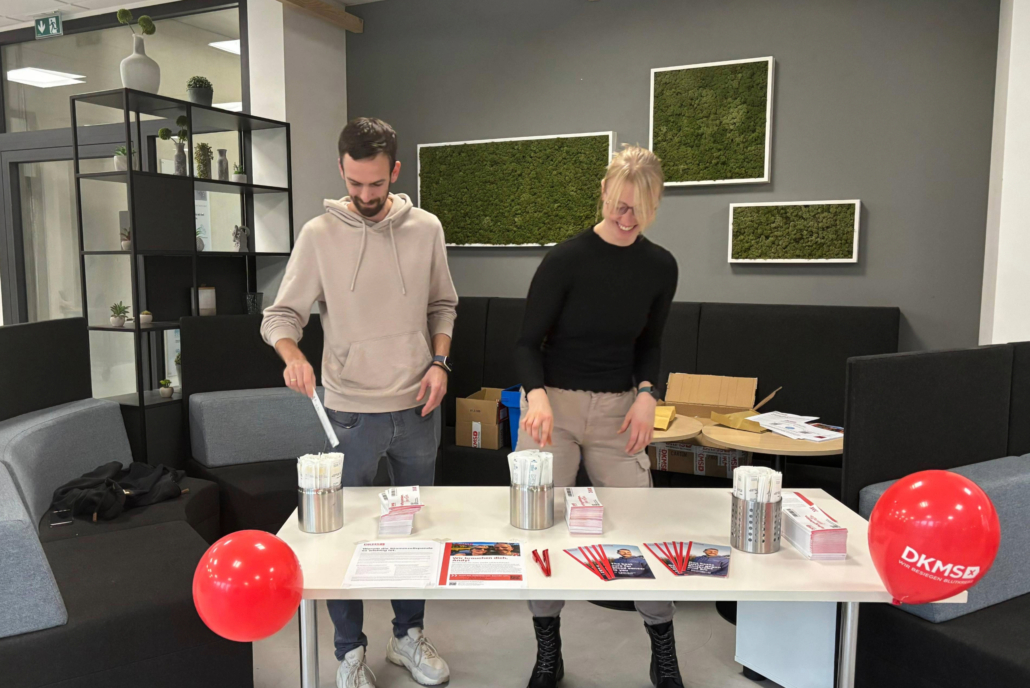
DKMS typing campaign at Schuchmann
Our long-standing business partner and friend Andreas Körber, Managing Director of Sanitätshaus medrob, is dependent on a stem cell donation due to a disease of the haematopoietic system. For this reason, we organized a DKMS typing campaign last week.
On 5 December, anyone who is not yet registered with the DKMS was able to be typed at our company site without any effort or cost. In addition to some of our colleagues, external volunteers also found their way to us and, true to the motto “Stick in, be a donor.” get typed.
We are repeat offenders!
We were able to draw on previous knowledge when preparing our typing campaign. After all, we launched such a campaign back in 2014. Back then, we supported the search for a suitable donor for little Martje from Osnabrück. A large part of our team is therefore already registered with DKMS. Many people from Osnabrück and the surrounding area joined in and were also typed. With success: Martje is doing well today and is healthy!
And we hope the same for Andy! Fortunately, we can announce that a suitable “match” has been found for him. We received the good news just one day before our campaign. Nevertheless, we would like to thank everyone who registered for DKMS. After all, one person in Germany is diagnosed with blood cancer every 12 minutes and the sooner a genetic match is found, the greater the patient’s chances of survival.
Thanks to the DKMS
Then as now, the cooperation with the German Bone Marrow Donor Center was absolutely uncomplicated, unbureaucratic and pleasant! We received all the documents and materials we needed for the typing campaign within a very short time. Many thanks at this point for the uncomplicated handling.
Why should I register with DKMS?
As previously mentioned, every 12 minutes in Germany someone receives the devastating diagnosis of blood cancer, worldwide every 27 seconds. Blood cancer is still the most common form of cancer in children. Many patients cannot survive without a life-saving stem cell donation, and the search for suitable donors is always a race against time. The faster a “match” is found, the greater the patient’s chances of survival.
What does a stem cell donation mean for me?
If you are shortlisted for donation, various tests will be carried out to ensure that you really are the right “match”. These include confirmatory typing and a comprehensive preliminary medical examination. If nothing stands in the way of a stem cell donation, two different collection procedures are possible:
- Peripheral stem cell donation (in 90% of cases)
- The donor is administered the growth factor G-CSF over a period of five days. This medication increases the number of stem cells in the peripheral blood, which are then collected directly from the blood using a special procedure.
- During the administration of the medication, flu-like symptoms may occur, but these quickly subside.
- The collection usually takes three to five hours at the most. This procedure has been used by the DKMS since 1996. Based on current research, no long-term effects are known.
- Bone marrow donation (in 10% of cases)
- A particularly large number of the vital stem cells are found in the bone marrow of the iliac crest.
- Under general anaesthesia, about 1 litre of bone marrow-blood mixture is removed from the donor.
- The bone marrow regenerates by itself within a few weeks.
- After the collection, local wound pain similar to that of a bruise may occur for a few days.
- A stay of 2 to 3 days in the hospital is necessary for the bone marrow collection. Afterwards, a few days of recovery at home should be planned.
- The risk of the bone marrow donation is low. As with any surgical procedure, there is a small risk of infection, haematoma or wound healing disorders.