Free DKMS typing campaign 2024
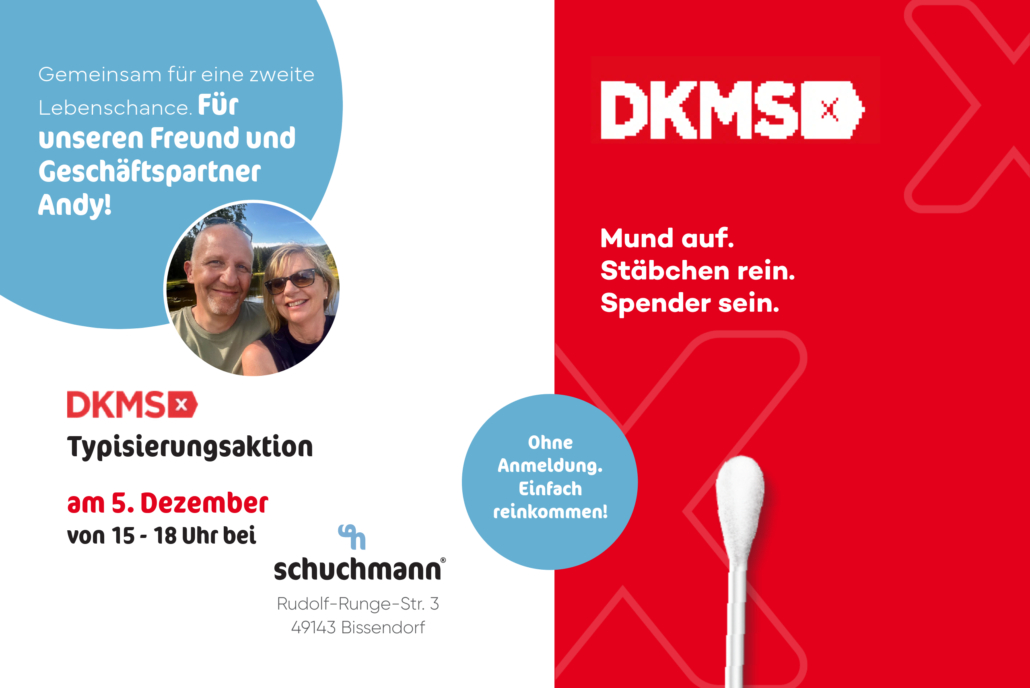
Our long-standing business partner and friend Andreas Körber, managing director of the medical supply store medrob, is suffering from a disease of the blood-forming system and is dependent on a stem cell donation. We would like to help where we can and have therefore organised a DKMS typing campaign.
On 5 December 2024, anyone who is not yet registered with the DKMS can be typified without effort or expense between 3 and 6 p.m. Registration is not necessary.
The campaign will take place at our company location (Rudolf-Runge-Straße 3, 49143 Bissendorf). To register as a donor, you only need your mobile phone, as you will enter your details there and go through the registration process automatically.
To summarise again:
What? Free DKMS typing campaign
When? 5th December 2024 between 3 and 6 pm
Where? Schuchmann GmbH & Co. KG. (Rudolf-Runge-Straße 3, 49143 Bissendorf)
Why should I register with the DKMS?
Every 12 minutes in Germany, someone receives the devastating diagnosis of blood cancer; worldwide, every 27 seconds. Leukaemia remains the most common form of cancer in children. Many patients cannot survive without a life-saving stem cell donation, and the search for a suitable donor is always a race against time. The faster a match is found, the greater the patient’s chances of survival.
What does a stem cell donation mean for me?
If you are shortlisted for a donation, various examinations will be carried out to ensure that you are really the right match. These include, among other things, a confirmatory typing and an extensive medical preliminary examination. If there is no longer any reason not to donate stem cells, two different collection procedures can be considered:
- Peripheral stem cell donation (in 90% of cases)
- The donor is administered the growth factor G-CSF over a period of five days. This medication increases the number of stem cells in the peripheral blood, which are then collected directly from the blood using a special procedure.
- During the administration of the medication, flu-like symptoms may occur, but these quickly subside.
- The collection usually takes three to five hours at the most. This procedure has been used by the DKMS since 1996. Based on current research, no long-term effects are known.
- Bone marrow donation (in 10% of cases)
- A particularly large number of the vital stem cells are found in the bone marrow of the iliac crest.
- Under general anaesthesia, about 1 litre of bone marrow-blood mixture is removed from the donor.
- The bone marrow regenerates by itself within a few weeks.
- After the collection, local wound pain similar to that of a bruise may occur for a few days.
- A stay of 2 to 3 days in the hospital is necessary for the bone marrow collection. Afterwards, a few days of recovery at home should be planned.
- The risk of the bone marrow donation is low. As with any surgical procedure, there is a small risk of infection, haematoma or wound healing disorders.