The best possible seating in the right therapy chair
1. Positive effects of correct sitting
Sitting is a basic human posture that is even more important for people with disabilities. A correct sitting posture is therefore very important to prevent deformities. Even for the youngest children, care should be taken to ensure that the spine, pelvis and hips do not suffer any damage from incorrect posture.
The right seating aid, which can be individually adjusted, not only prevents incorrect posture – it also makes sitting as comfortable as possible. Incidentally, the best possible sitting position not only has a positive effect on back health, but also on digestion and breathing. You also don’t get tired as quickly, and most importantly: children and young people can take part in everyday life, play with friends or do other activities. This also relieves the burden on parents and teachers.
Discovering the world while sitting
Each seating aid offers the necessary safety and the hands remain free to play. The greatest possible freedom of movement can be created with a removable back. The freedom that this gives the child in the upper back area motivates them to stand up and be active. However, children should never remain in the same position for a long time. Our seating aids therefore offer many ways to change position. For example, the seat can be tilted forwards or backwards. There are also aids that enable active sitting: here, the back rocks with the movement of the child. This can reduce physical and mental tension.
It is important to us that all seating aids are tailored to the needs of children, parents and therapists. This means that they can be used in a variety of ways, are easy to handle and offer a wide range of functions to make children feel comfortable. And not just when sitting, but also when lying down. That’s why we also offer a lying system for children who suffer from extreme contractions and pressure sensitivity. In this mobile lying system, the little ones feel comfortable. They can relax and be brought into a sitting position for a short time.
2. Which therapy chair is right for my child?
There is a wide range of therapy chairs available for children and young people with disabilities. Keeping track of them all and finding the right seat can be tiring. We have compared our seating aids to give you a quick overview. However, this is no substitute for expert advice from a specialist retailer or from the therapeutic or medical sector.
3. GMFCS level and ICF codes
The GMFCS level (en: Gross Motor Function-Level) indicated for our aids can provide a rough classification of the suitability of the aid for a child or young person with a disability. GMFCS is a simplified classification of the gross motor skills of children and young people. This classification can be found on each of our products. You can find a more detailed explanation of the individual GMFCS levels in our catalogue on page 10.
The ICF codes given below also provide information on the classification of the so-called components of health based on the bio-psycho-social model. This describes the components “body functions”, “body structures”, “activities and participation” and “environmental factors”, taking into account the interaction between the various components. To illustrate this model, we can refer to the article by the Federal Institute for Drugs and Medical Devices. For ease of understanding, we have listed the codes that are most important for the article below:
Body structures/functions:
s710 – Structure of the head and neck region
s720 – Structure of the shoulder region
s730 – Structure of the upper extremities
s740 – Structure of the pelvic region
s750 – Structure of the lower extremities
s760 – Structure of the trunk
b730 – Functions of muscle strength
Activities / Participation:
d160 – focusing
d415 – remaining in a body position
d550 – Eating
d560 – Drinking
d710 – Basic interpersonal communication
d750 – Informal social relationships
d815 – Pre-school education
d820 – School education
d880 – playing
d910 – community life
4. The different therapy chairs
Small support, big impact.
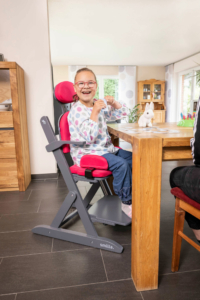
Therapy chairs such as our smilla. (GMFCS 1-3) score points for their aesthetic appearance and their almost invisible support. This type of aid is intended for children and young people who require little support. The children should be able to control their head independently and maintain a basic body tension in order to be able to sit well in this seat aid. Optional leg guides, thoracic supports or belts can be used for positioning if required. smilla. can be easily adjusted in height, seat angle and seat depth, so that even with little support, the needs of children and young people can be optimally met (ICF code: s710 – s760). Quick-release adjustments, e.g. using knobs or push buttons, make it easy to respond to different situations, e.g. in the context of a kindergarten (ICF code: d815, d880, d750).
Therapy chairs for every occasion
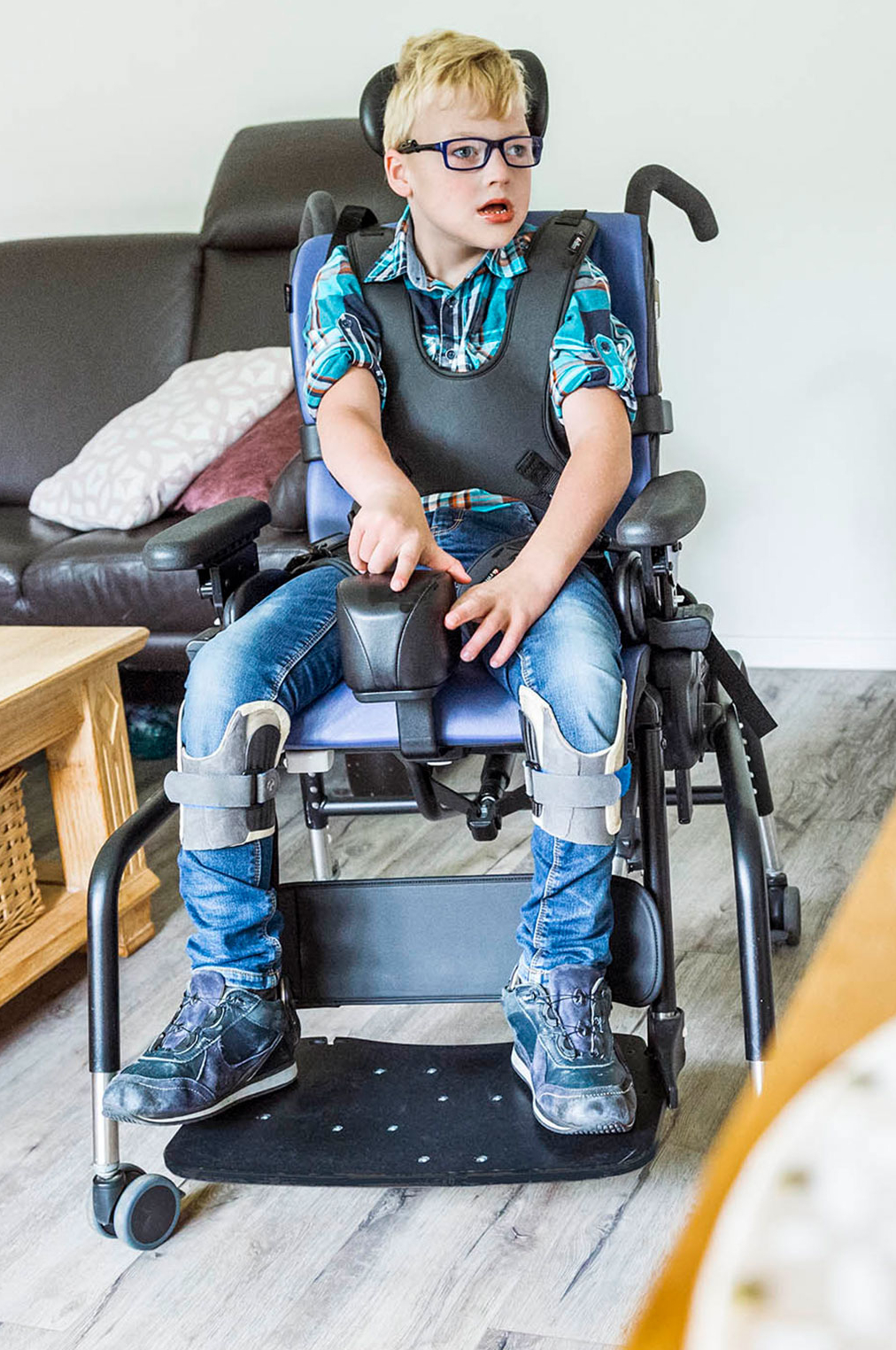
Therapy chairs from our madita. family (GMFCS 3-5) offer more support. The ergonomically shaped seat ensures good positioning of the pelvis. Thigh guides or an abduction wedge can contribute to positive pelvic development. A dysplasia seat can also be used as an option to support the development of the hip joints (ICF code: s740). The optionally removable back unit offers the possibility of activity, but can also provide even more support with the help of an upper arm guide (ICF code: d415). The height- and angle-adjustable footrest ensures the optimal positioning of the feet (ICF code: s750). If necessary, a foot strap can gently improve the position of the feet. If head control is limited, various headrests provide more support.
Sturdy and stable
madita. is one of our most frequently prescribed aids. And for a simple reason: optimal support and easy handling. True to the motto “Everything can, nothing must”, madita. supports children and young people where it is needed (ICF code: s710 – s760). Its wide range of accessories can be positioned according to individual needs and offers room for therapeutic success.
Once adjusted, the sitting position can be varied so that children and young people never have to remain in one sitting position for long. In addition, madita. is as space-saving as possible thanks to its underframe. This means that new muscle groups are constantly being addressed when sitting. In everyday school life, madita. can be quickly adjusted to different table heights as a work chair (ICF code: d820). The optimal and adjustable sitting position improves concentration during the school day (ICF code: d160). It also makes writing on the blackboard, at a desk or eating at the kitchen table possible without any problems (ICF code: d710, d910, d550 & d560).
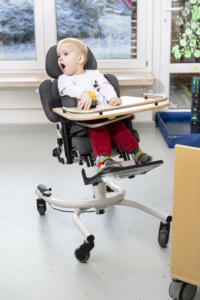
More play, more fun.
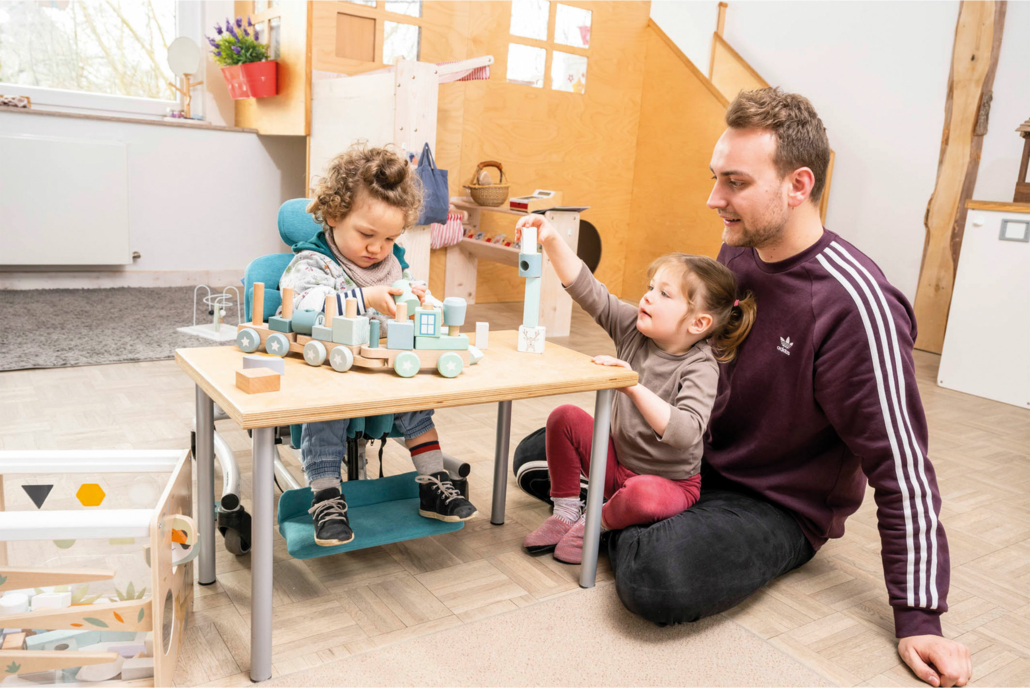
If children need a therapy chair that allows them to sit and, above all, play more actively, madita-fun. is the right choice. The main difference between it and madita. is the underframe, which can be lowered to floor level. This makes it possible to play at eye level or even to transfer independently, as well as to eat at table height (ICF codes: d710, d910, d550 & d560). The active backrest on madita. or madita-fun. ensures greater freedom of movement in the upper body and pelvic area (ICF codes: s760, b730).
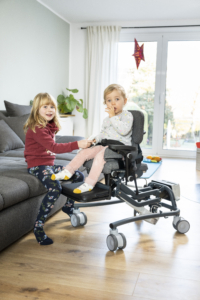
Optimal care for the youngest children.
madita-fun mini. offers support for the youngest children. It is designed to ensure that even the smallest children can be optimally positioned and have fun at the same time. madita-fun mini. combines the features of madita-fun. and is adapted to the needs of children up to 20 kg. It can be lowered to the floor to enable children to play at eye level (ICF code: d710, d910). Options such as the anatomical seat or the dysplasia seat ensure the positive development of the hip joints. Optimal positioning with the help of a suitable therapy chair is particularly important in the initial phase to avoid subsequent damage.
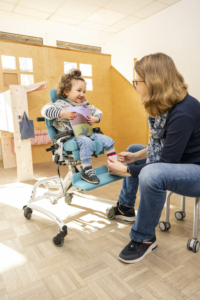
A place of calm for restless children and young people.
Our madita hd. therapy chair can withstand high loads. Its base frame is reinforced to provide safety for children and young people with a high level of energy. madita hd. is well padded with increased safety to ensure a comfortable sitting experience. The seat can be adjusted in height and angle to provide more variability in the sitting position. While the activity chair. described below follows the child’s movements, the reinforced basic model provides stability and security for restless children and adolescents (ICF code: b760).
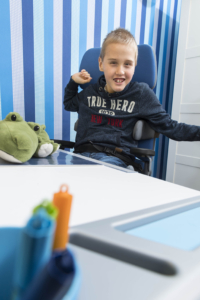
A work chair for the big kids.
The madita maxi. is perfect for big kids or small adults. As a therapy chair, it has the same easy adjustability as the madita. and is therefore a solid companion as a work chair at school or in leisure activities (ICF code: d710, d910). The anatomically shaped seat cushion and the armrests with extra-wide pads provide the necessary comfort.

For rockers big and small.
The activity chair. (GMFCS 2-4) from our distribution partner Rifton offers – like our madita hd. – support for very active children. While madita hd. absorbs movements and thus provides stability, the activity chair. moves with the child, allowing them to relax and rest (ICF code: b760). For more participation, the optional high-low base can be lowered to the floor. This is of great importance for the possibility of independent transfer (ICF code: d710, d910).